Saturday, 14 December 2013

07:37 Posted by sistema de las Víctimas No comments

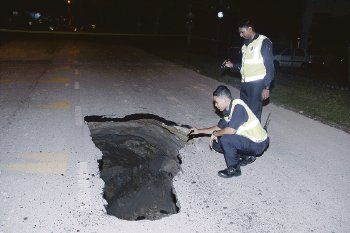
SUBANG JAYA: A portion of the road leading to houses and shoplots in Section 5, Taman Kinrara, off Batu 9, Jalan Puchong, collapsed yesterday, leaving a six-metre deep and 4.5-metre wide sinkhole. 

The incident happened at 2pm. The earth in the middle of the road suddenly caved in, leaving a hole deep enough to fit four cars. 

Luckily, no road users fell into the hole, located near several apartments, 

Serdang police chief Superintendent Abdul Razak Elias said police were notified about the sinkhole at Jalan TK 5/1 by residents, before several officers cordoned off the area. 

"We decided to close the road pending investigations and repair works by the Subang Jaya Municipal Council." 

A check at the scene showed policemen and officers from municipal council inspecting the sinkhole. 

They said the problem was most probably caused by underground waterways.
07:01 Posted by sistema de las Víctimas No comments
GEORGE TOWN: Traffic along Macalister Road here slowed down to a snail’s pace after a sinkhole appeared on the road, near the site of the lightning arrester collapse which killed a motorist in June.
The hole, measuring about 0.6m in diameter and 1m deep, is located in the middle of the road in front of the Pakistani Mosque.
Komtar assemblyman Teh Lai Heng said a preliminary probe by the Penang Municipal Council’s engineering department showed that a leaking sewerage pipe about 3m away had caused soil erosion beneath the road, resulting in the cave-in at about 1.15pm yesterday.
He said the section of the road had been cordoned off and an iron plate would be placed over the sinkhole for the time being.
“Indah Water Konsortium has been notified and will carry out repairs tomorrow (today).
On Aug 14, a forklift fell into a hole when the road in front of the Pakistani Mosque caved in during work to repair damage caused by the lightning arrester collapse.“Digging works and repairs are expected to take a few days,” he added.
The remains of 44-year-old hawker Lim Chin Aik is believed to be buried in the ground when the lightning arrester from atop the 21-storey Menara Umno snapped during a storm and crashed into his car.
Lim was presumed dead when pieces of his car were found in the crater that resulted from the impact.
On June 23, Lim was “laid to rest” in a simple funeral ceremony at the Kek Lok Si Columbarium, where an urn containing mud which his wife, Lee Chai Song, 48, had scooped from the crater, was placed.
06:31 Posted by sistema de las Víctimas No comments
IPOH - Several sinkholes, between three and five metres in diameter and three metres deep, have appeared in Jalan Hasan near Lim Garden here.
The latest sinkhole, the third in less than a week, appeared in front of SK Tarcisian Convent yesterday, which almost caused a 59-year-old his life.
Lorry driver Teoh Wooi Boon had parked his one-tonne lorry by the side of the road, in front of the school, to answer a phone call when a sinkhole suddenly appeared.
The gaping hole "swallowed" the front passenger tyre, which resulted in the lorry tilting to its side.
A visibly shaken Teoh said he got out of his vehicle to check and was shocked to see the sinkhole, which was five metres in diameter and three metres deep, the biggest sinkhole spotted in the city.
"It all happened so fast. I am lucky to have escaped unhurt. I dread to imagine what would have happened if my lorry had fallen into the sinkhole."
Checks by the NST showed that there was a sinkhole within the school compound and another just a stone's throw away.
Construction work is ongoing for an extension of the school at an adjacent plot of land.
An Ipoh City Council spokesman believed the sinkholes could have appeared due to piling works for the school extension project, which began two days ago.
"I have spoken to the contractor c and all piling works will stop with immediate effect.
"We will also cordon off the affected areas and rope in experts, including geologists, to help us determine the cause behind the emergence of the sinkholes," he said, adding that it would come out with a report soon.
06:20 Posted by sistema de las Víctimas No comments
 Sinkholes can be natural or man made. Natural sinkholes occur due to erosion or underground water. They start developing long time before it actually appears. The ground beneath our feet is not as much of a solid structure as we think it is. The ground is made from dirt, along with many rocks and minerals. There is water continually seeping in between the mud, rocks and minerals, as it makes its way down to the ground water reservoirs. As this happens, the water slowly erodes the rocks and minerals. Sometimes the flow of water increases to a point when it washes away the underground structure of the land. And when the structure becomes too weak to support the surface of the earth, it collapses and opens up a hole. This is how sinkholes are formed.


Humans are also responsible for the formation of sinkholes. Activities like drilling, mining, construction, broken water or drain pipes, improperly compacted soil after excavation work or even heavy traffic can result in small to large sinkholes. Water from broken pipe can penetrate through mud and rocks and erode the ground underneath and cause sinkholes. Sometimes, heavy weight on soft soil can result in collapse of ground, resulting in a sinkhole. Sinkholes can also form when the land surface is changed.
Areas that have a bedrock made of limestone, salt deposits or carbonate rock are most susceptible to erosion and  the formation of such holes. These rocks tend to erode as acidic water passes through them. When rainwater passes through decaying plant debris, it tend to become more acidic.  Over a period of years, overlying sediments collapse and a sinkhole develops. Sometimes the holes are small, measuring a few feet wide and ten to fifteen feet deep. Others can be hundreds of miles wide and deep. However, all of them can be dangerous for those that get caught in them. There are three major kinds of sinkholes. Their formation is determined by the same geological processes, barring a few differences.
- See more here
05:58 Posted by sistema de las Víctimas No comments
There are three type of sinkholes.
First one is solution sinkholes Solution sinkholes form where soluble bedrock (i.e., limestone, dolomite, marble, and rock salt) is exposed at the land surface and thus subjected to weathering by dissolution.  Surface water collects in natural depressions and slowly dissolves a sinkhole.  Second one is subsidence sinkholes. Subsidence sinkholes are similar to solution sinkholes, except that the soluble bedrock is covered by a thin layer of soil and/or sediment. Surface water infiltration dissolves cavities where the bedrock is most intensely fractured, and the overlying sediment gradually moves downward into the expanding cavity.

Third one is collapse sinkhole. Collapse sinkholes form when surface materials suddenly sink into a subsurface cavity or cave.  The cavities form slowly over time, as groundwater moves along fractures in soluble bedrock and enlarges them through dissolution, and the actual collapse can occur in two different ways:                a.  When a cavity gets sufficiently large, the "roof" becomes too                   thin to support the weight of any overlying rock or sediment,                   so it collapses into the cavity.                 b.  Caves are sometimes able to support the weight of overlying                   sediments because they are filled groundwater.  However, if                   groundwater levels are lowered, then the overlying sediment                   will first erode and then collapse into the dewatered cavity.
05:26 Posted by sistema de las Víctimas No comments


Where usually sinkholes happened? Is it can be at any place? No. There are certain characteristic that can give you sign that certain area has a potential to have sinkholes in any minutes.

It happened in area where the bedrock is form from soft mineral and rock. There are such as salt, gypsum, limestone, dolostone and others types of carbonate rocks. This is because for that type of rocks, they are very easy dissolve with water especially acid type either it is come from rain water or eroded by movement of groundwater under it. When the dissolution process occur, in time the size of hole become bigger until it cannot hold the load on it and collapse.
04:45 Posted by sistema de las Víctimas No comments


What it is sinkholes? 
Is it type of holes in kitchen sink?
Or what?

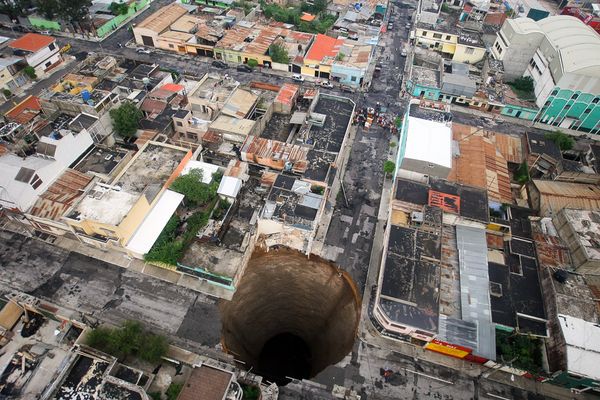
Sinkholes are considered a type of land subsidence, because they involve a vertical  downward movement of the land surface. There are three types of sinkholes, each of which forms in a different way. Collapse sinkholes are the most hazardous to humans because of how suddenly they can form. Sinkholes aren’t uncommon, as about 10 percent of the world’s landscape is composed of karst regions.


Want to know how it happens? Move and put some energy on your mouse here!
                     

Blog Archive

Geologist

Geologist

Bookmark Us

Delicious Facebook Favorites More Stumbleupon Twitter

Search